

Steppenwolf’s New Show is a Windfall of Emotions, Realizations, Music, and Questions
Bonnie DeShong
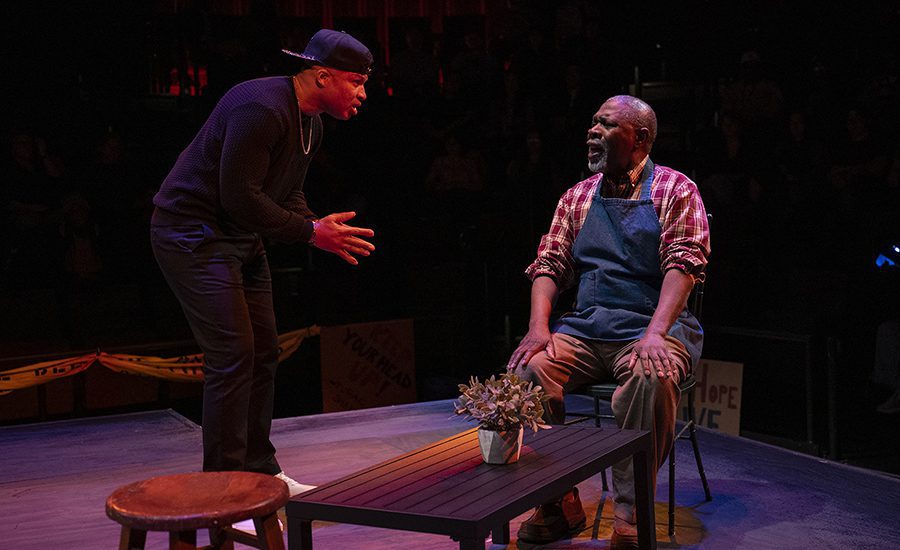
Oscar-winning playwright Tarell Alvin McCraney set this play in Chicago. Henri “Mr. Mano” Tamaño (Michael Potts) has worked hard to own his home and raise his children. His oldest adopted child, Marcus (Glenn Davis), is dead but hangs around having conversations with Mono on a daily basis. Mono has a youngest child, Eli (Esco Joley), whom he hasn’t seen in six months after an argument.
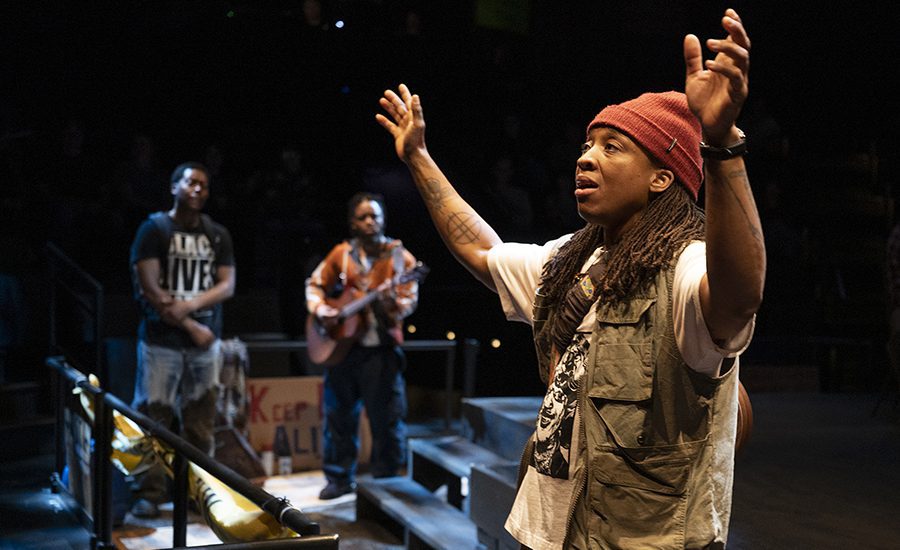
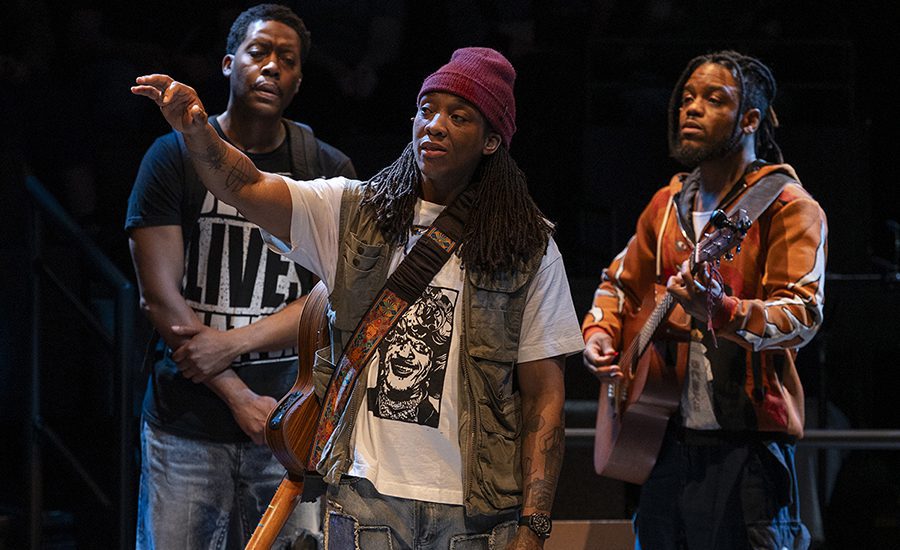
Eli and friends, Cori (Jon Michael Hill), and Brother 1 (Namir Smallwood) start a band that sings against injustice. They find themselves actively involved in a protest at a building where a child has been unlawfully taken inside. The police shoot into the crowd, and Eli is hit and pronounced dead.
The City of Chicago offers Mono money to settle with the city over Eli’s death. They send letters, and finally, they send three strangers. Each stranger puts pressure on Mono to take the money, but he must state that the City and police are not at fault. Marcus tells him to take the money. How much money would it take for a Black father to clear the City of the death of his child?
I asked the Artistic Director side of Glenn Davis how it came about that Tarell wrote this particular play for Steppenwolf. He responded, “We went to him and said, ‘Hey, would you write something to christen this theater in terms of a commission, a first presentation of this play?’ And he said, ‘Absolutely.’ Then our second request was that he write the play that he was scared to write. That was the prompt that he needed.” I must say that Tarell went all out, as only he can.”

There is a lot of audience participation, which really made us feel as if we were a meaningful part of the production. Another character in the play is the music. The cast breaks out into soulful sounds from Marvin Gaye to Sly and the Family Stone, and many more. The music and voices of the actors are so good that the audience can’t help but sing along loudly and clap their hands.
Glenn explained that one of the things we may underestimate about a play like this is, while it deals with very real and serious circumstances—because it’s Tarell Alvin McCraney—whether you’ve seen *Moonlight* in film, *Choirboy*, or the *Brother/Sister* plays on stage, the thing that is always infused into his work is humor. Many times, he’s writing about folks who are underprivileged or from the proverbial wrong side of the tracks. One of the great things that helps folks be the best version of themselves or live out their lives in a way that has nothing to do with monetary gain, but more to do with their true happiness, is music and humor. He infuses his plays with a lot of lyricism in terms of his language, beautiful music, whether we make it ourselves or whether it’s a song that is sung, and humor.
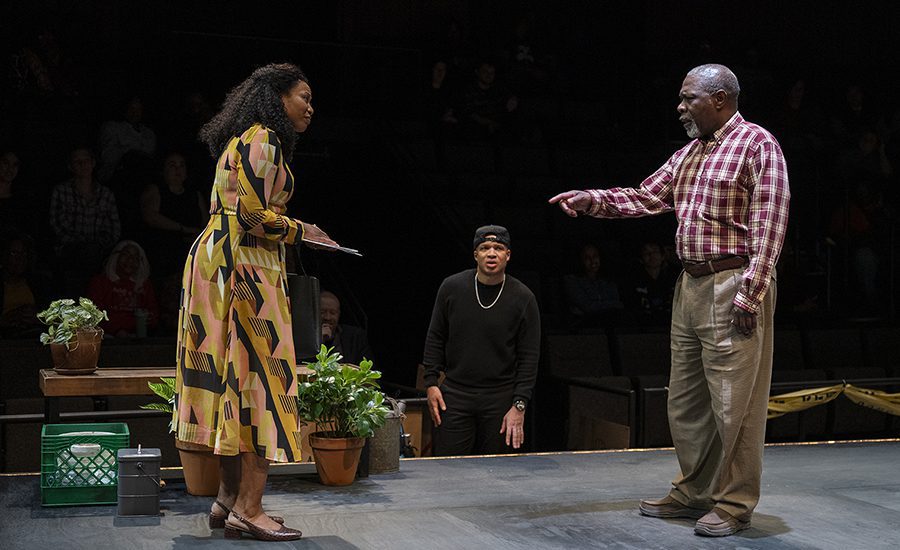
The casting is fantastic and on point. Steppenwolf Ensemble member Alana Arenas plays all three roles of First Lady, Miss Second, and The Last One. She portrays each character totally differently. It reminded me of the three ghosts from *A Christmas Carol* in a good way. She is the sauce of the play. Each of the characters is totally different, and she pulls it off seamlessly.
Michael Potts is the perfect father who has lived his life, in some ways, not the way he wanted, but he was a good father and man.
During the play, Mono hums and sings throughout. It is truly a part of his character, and the songs give us a deeper look into who Mono is. I asked Michael Potts about the music. He explained, “Well, for the character of Mono, as Tarell says, Mono uses music when he’s sad. Also, Eli repeats that as well; whenever he or Eli needs to focus or calm themselves, they use music as a way to cope. I think, in general, he’s talking culturally as well—the power of music to soothe one’s soul, basically. I think that’s what he’s doing with Mono. Music is in all of his plays. It permeates them; it is a character of its own. I think in all of his pieces. But yeah, I think he sees it as a communal thing. He sees it as a therapeutic thing and as a very present and vital being within the play.”
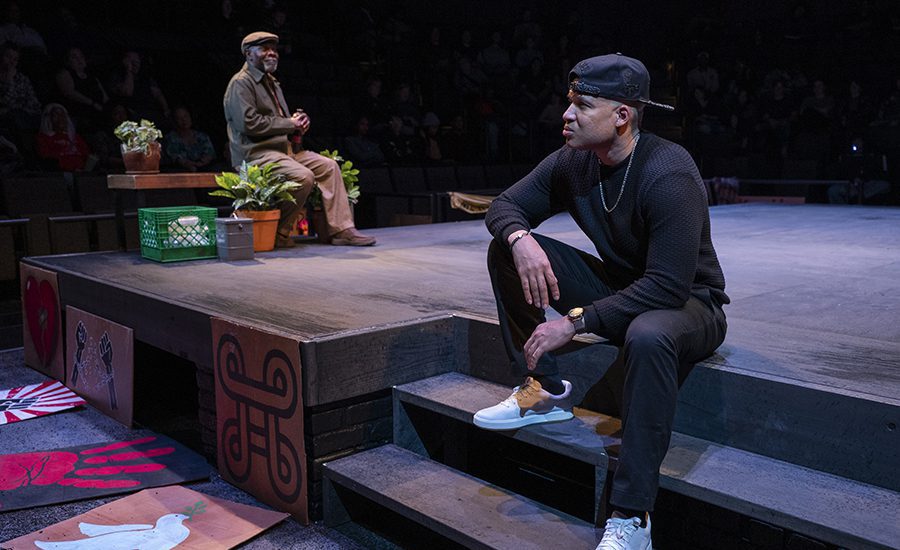
Glenn Davis as Marcus is, while funny, also a character who brings real seriousness to the time and what he feels his father needs. It is a very interesting character because he really wants Mono to take the money. It gets intense while still having humor. I asked Glenn to explain why, if Marcus is dead, he wants Mono to take the money. He explained, “Well, if I were to take what Marcus says as his truth in the play, he feels like he wants to pay Mono back for the way he’s treated him, the way he’s looked after him, and accepted him for who he was. Obviously, the play is happening after Marcus has passed away. So, Marcus explains at the top of the show what has sort of transpired up to this point. Then, he later says in the play, when he’s sort of speaking his truth to Mono, ‘This is the reason why I’m here. This is why I’m still around. I still exist for you.’ No one else can see Marcus in the play aside from Mono, but he explains to him, ‘There’s a specific reason I’m here, and I won’t leave until I get done what I need to do.”
Esco Jouley is amazing as Eli. As an audience member, I felt for Eli. I was warmed by Eli. I was happy with Eli. I mean, every emotion that I could have for a character I had with Esco playing this role.
Glenn expressed that in casting the roles of Mono and Eli, these were parts they had to get right. In this case, the character Eli is the subject of the play, and Mono is the object of the play. He went on to say, “And those two work needs to be in sync, and the two of them are. We were looking for this part, which is a very specific role. When we were made aware of who they were, we held auditions. We talked to them, and it was like, ‘Okay, this is exactly the person we want for this part.’ It just fit like a glove. Once we started rehearsals, it was like, ‘Oh yeah, we made the right choice.’ Esco is fantastic in this role. They’re talking to the audience, they’re playing music, they’re singing, they’re acting their tails off. They take us into the depths of social consciousness, love of self, and knowledge of who they are.”
Steppenwolf Ensemble members Jon Michael Hill and Namir Smallwood play duo roles that are truly important to the play. They are the seasoning that brings everything together.
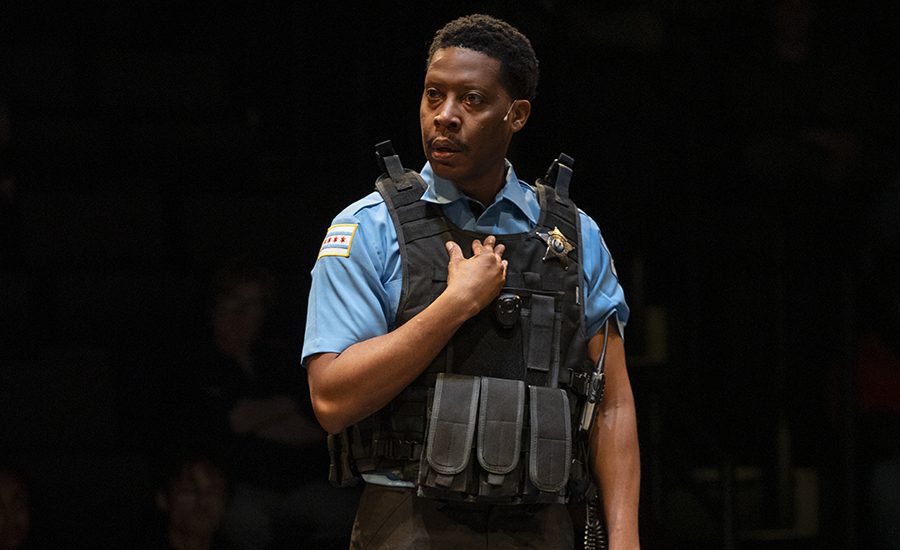
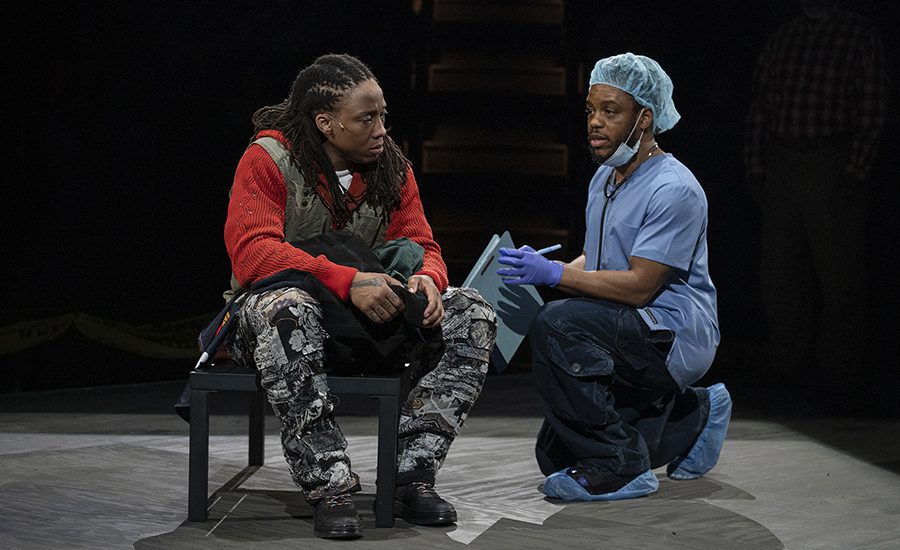
I asked Glenn to sum up the experience of WINDFALL. He said, “By the end of the play, I feel like you’re called to either do something or question your own beliefs and figure out if what we’re doing is sustainable and if we are heading in the right direction as a community, as a culture. So, when you come to the play, prepare to be entertained, prepare to laugh, prepare to cry, but also prepare to be challenged and to really consider your place in the world we live in today.”
WINDFALL is more than a play about money. As you leave the theater, I’m sure you will ponder the question: if a Chicago police officer shot your child and the City offered you a seven-figure check to say that they were not at fault, would you take it?
I give WINDFALL 4 ½ winks of the EYE.
Until next time, keep your eye to the sky!