
The Doctors—A Crew of Young Black men from Mendel Catholic High School who Elevated the School’s Parties to New Prominence.
Bonnie DeShong
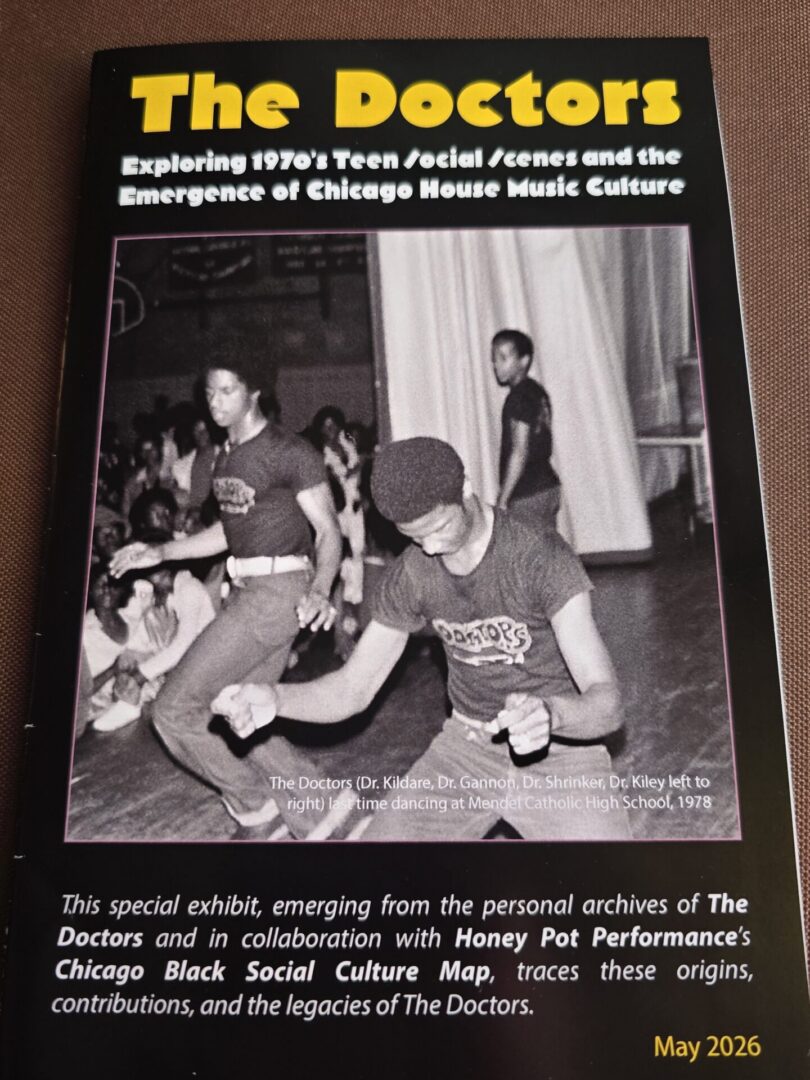
Recently, I attended an exhibit produced by Honey Pot Performances and curated by The Chicago Black Social Culture Map (CBSCM) titled, The Doctors—a crew of young Black men from Mendel Catholic High School who elevated the school’s parties to new prominence.
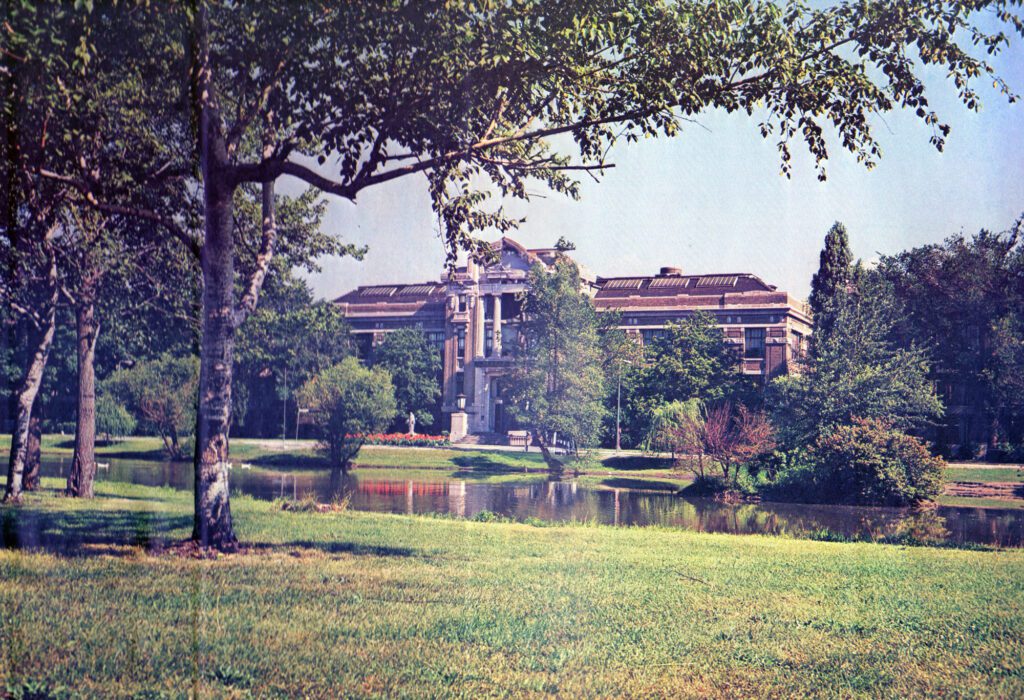
The exhibit is small but powerful, consisting of videos, pictures, and articles, as it gives us a look into the late 70’s when Catholic schools were all boys, or all girls, and the social scene is what brought them together.
In the early 70’s, the Black community was known for its gangs. That changed when the high school social clubs came on the scene.
I knew about the Doctors at Mendel because my cousin, Steve Taylor, was “Dr. Casey” in the group, but I had no idea of the impact these social clubs had on the teen social scene during that time.
“Formed in the mid-1970s, The Doctors were a crew of young Black underclassmen at the all-boys Mendel Catholic High School who, in their time there, elevated the school’s parties to new prominence and have had a lasting impact in their communities and beyond. Their cultural contributions are evident in and critical to the history and culture of house music, from its promotion to the style, to dance, to music, and more.” (Honey Pot Performance)
As I walked through the exhibit and then visited the website (https://www.honeypotperformance.org/the-doctors-exhibit) to see and learn more, I was amazed at what these young men did to produce the successful parties that thousands of kids attended, without any violence or fights. The only “fights” were dance-offs on the dance floor.
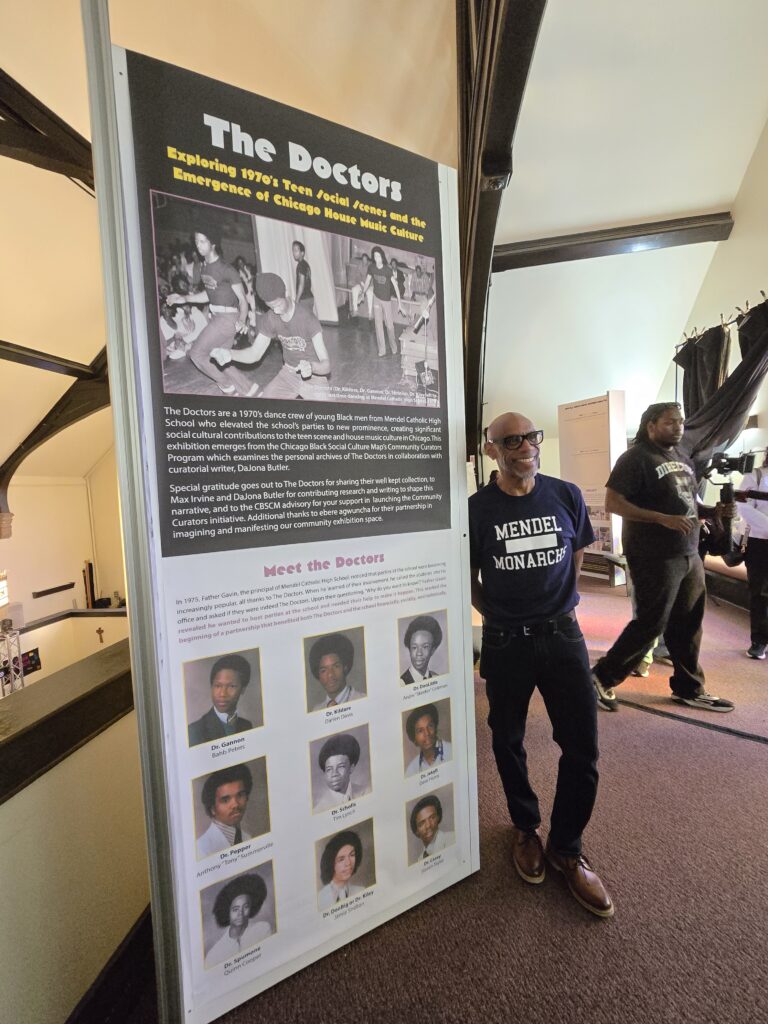
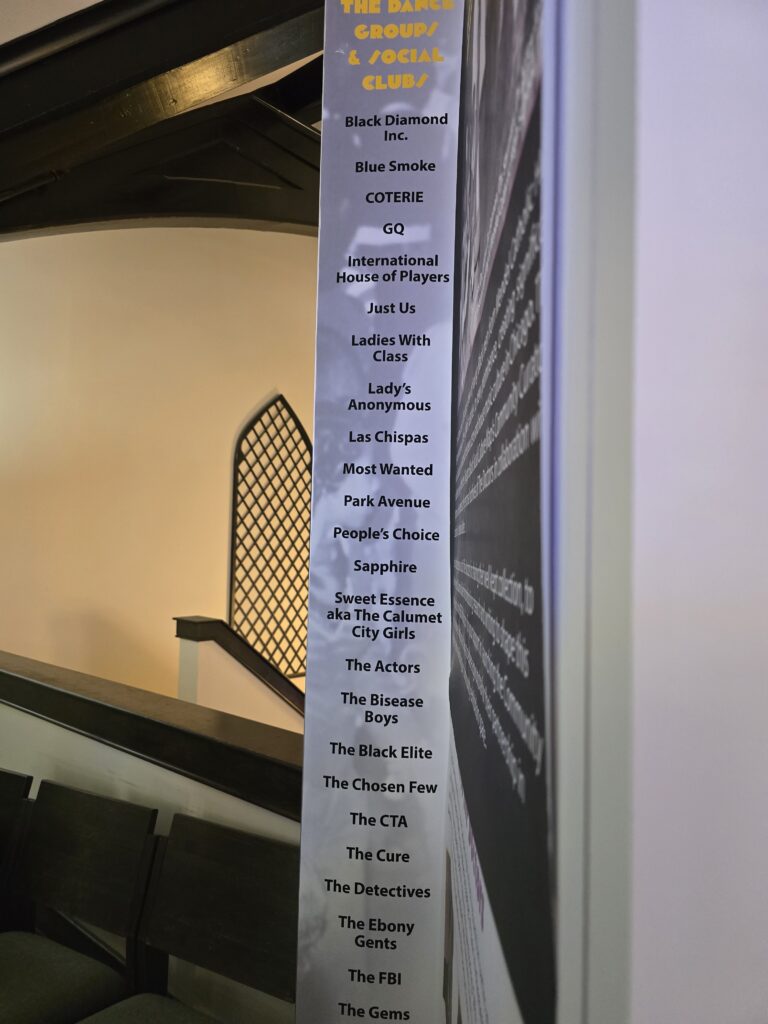
How did they become the Doctors? Their biggest rivals were The Bisease Boys and The Cure, so they decided they would be the remedy to The Bisease Boys and became The Doctors, with each member adopting a unique doctor name. Bahb Peters, also known as Dr. Gannon, Darien Davis, Dr. Kildare, Andre “Skeeter” Coleman, aka Dr. Doolittle, Jamie Shelton, aka Dr. Kiley, Anthony “Tony” Summerville, aka Dr. Pepper, Steve Taylor, aka Dr. Ben Casey, Rory Brown aka Dr. Shrinker, Dave Harris, aka Dr. Jekyll, Tim Lynch, aka Dr. Scholls, and Quinn Cooper aka Dr. Spumone.
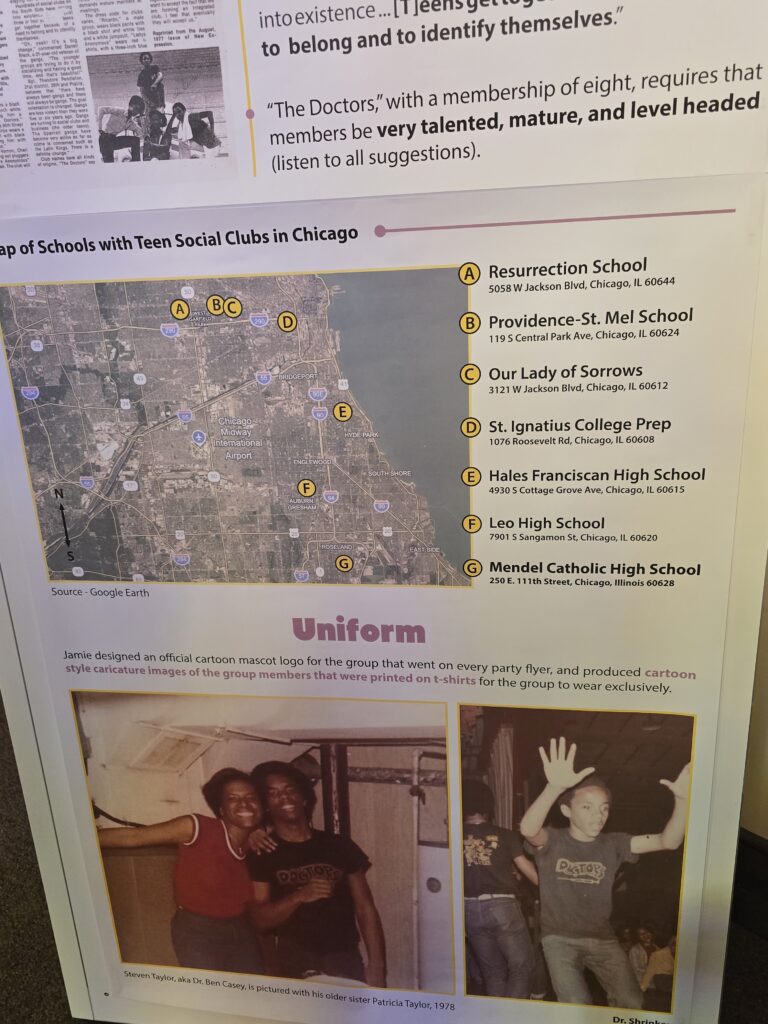
At the opening of the exhibit, I listened in on a couple of conversations between some of the social club members, the ladies who were girls at the time, talking about how the guys were always respectful to them. Of how their parents wouldn’t allow them to go to certain places, but would drop them off at Mendel for a party The Doctors were giving.
I had the honor of interviewing my cousin Steve Taylor about The Doctors and their impact on the man he is today.
It seems the guys didn’t realize they were becoming businessmen. As time went on, they marketed by creating pluggers designed by Jamie Shelton and delivering them to all-girl schools. They handled the money they made from the $2.00 admissions to roll into the next party, and they gave back some of the profits to Mendel without holding money for themselves individually.
You can’t have a jammin party with great promoters Tony Smith: MCHS1979, Craig Thompson: MCHS 1977, Craig Thompson: MCHS 1977, Kirk Townsend: MCHS 1978. The DJs rocking the parties were Ron Hardy, Frankie Knuckles, The Chosen Few, Lori Branch, and Celeste Alexander.
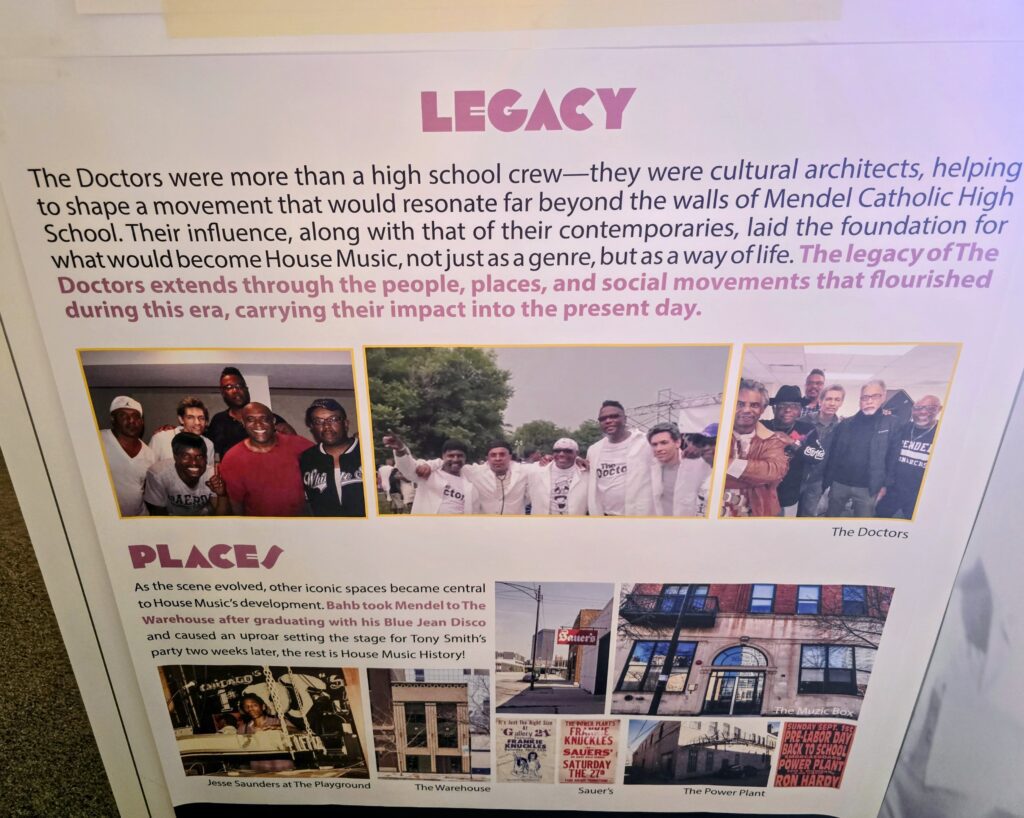
The exhibit states, “The Doctors were more than a high school crew—they were cultural architects, helping to shape a movement that would resonate far beyond the walls of Mendel Catholic High School. Their influence, along with that of their contemporaries, laid the foundation for what would become House Music, not just as a genre, but as a way of life. The legacy of The Doctors extends through the people, places, and social movements that flourished during this era, carrying their impact into the present day.”
It goes on to say, “As the scene evolved, other iconic spaces became central to House Music’s development. Bahb took Mendel to The Warehouse after graduating with his Blue Jean Disco and caused an uproar, setting the stage for Tony Smith’s party 2 weeks later, and the rest is House Music History! The Warehouse—where Frankie Knuckles, the Godfather of House, famously fine-tuned the sound that would come to define the genre—was a sanctuary for dance and self-expression. Frankie would then go on to create and DJ at his own club, The Power Plant. After Knuckles left The Warehouse, Ron Hardy was a DJ at the Warehouse’s new location, which was later renamed The Muzic Box. Lori Branch, often recognized as Chicago’s pioneering female house DJ, had her first club performance at Sauer’s. In 1982, the Playground opened and hosted DJs like Frankie Knuckles, Jesse Saunders, Farley “Jackmaster” Funk, The Chosen Few, and others, playing a mix of disco, funk, European synth tunes, and gospel influences, contributing significantly to the development of house music. Each of these spaces contributed to the refinement and spread of the music. These were more than clubs; they were temples of rhythm, where community and creativity merged on the dance floor.”
The Chicago Black Social Culture Map (CBSCM) has put so much into this exhibit, bringing back the history of not only The Doctors but also the culture of the time. The deep memories of teens going to have fun from all over Chicago and making it home safely with out incident. Where you danced so hard, girls would sweat their hair back to its natural state, and guys would leave with shirts soaking wet. A time when a guy you didn’t know would ask you to dance, and you would gladly hit the floor and dance all night.
You can view the exhibit and take a walk back in time on the Honey Pot Performance website https://www.honeypotperformance.org/the-doctors-exhibit.
I give The Doctors Exhibit 5 out of 5 winks of the EYE
Until next time, keep your EYE to the sky!
The Chicago Black Social Culture Map (CBSCM) is a public humanities platform and community archive for the preservation of Chicago’s Black social cultural lineage—past, present, and future.
Honey Pot Performance (HPP) is a Chicago-based creative collective and nonprofit organization that has been active for over 25 years, focusing on Afro-feminist and Black diasporic experiences in contemporary life